
Landlords guide
Smoke Alarms and RCDs: What WA Law Requires Before You Sell or Lease
WA law requires compliant smoke alarms and at least two RCDs before a home is sold, rented or hired. Here is what that means, and when it must be done.
Western Australian law requires compliant mains-powered smoke alarms and at least two residual current devices protecting all power and lighting circuits before a dwelling is sold, rented or hired, and for a sale, both must be in place before the title transfers. These are not recommendations, and leaving them until the week of settlement is how otherwise straightforward transactions come unstuck.
This guide sets out what each requirement actually says, who is responsible, what “compliant” means in practice, when the work has to be done, and the handful of exceptions that genuinely apply.
Requirements below were checked against Building and Energy and Consumer Protection WA material on 22 September 2026. Safety legislation changes; confirm current requirements before you rely on this.
What does WA law require for smoke alarms?
Compliant smoke alarms must be installed before transfer of ownership, before a new tenancy begins, and before a dwelling is made available for hire. Building and Energy, the regulator within the Department of Energy, Mines, Industry Regulation and Safety, sets this out in its guidance on smoke alarm laws for homes being sold, rented and hired. The requirements are mandated under the Building Act 2011 and the Building Regulations 2012.
Three elements make an alarm compliant:
- Power source. Alarms must be permanently connected to the mains power supply. Battery-only alarms do not satisfy the requirement except in the narrow circumstances below.
- Age. Alarms must be not more than ten years old and must not have reached their expiry date. This is a hard rule and it catches sellers who assume an alarm that beeps is an alarm that complies.
- Standard. Alarms must comply with Australian Standard AS 3786. The Department of Fire and Emergency Services recommends photoelectric-type alarms.
That ten-year rule is the one worth acting on today rather than at settlement. Look at your alarms: the manufacture or expiry date is printed on the unit. If it is approaching ten years, replace it now, while you can book an electrician at an ordinary time rather than inside a settlement deadline.
When can you use battery-powered smoke alarms instead?
A ten-year lithium battery alarm is permitted only where mains power genuinely cannot be run, not simply where running it would be inconvenient or expensive. Building and Energy allows the battery alternative where there is no hidden space in which to run the electrical wiring for a mains-powered alarm and no appropriate alternative location is available.
The examples given are structural rather than discretionary: concrete ceilings, or flat roofs with no ceiling space above. Local government approval may be required in some cases.
| Situation | What is required |
|---|---|
| Standard home with roof space | Mains-powered alarms |
| Concrete ceiling, no cavity to run wiring | 10-year lithium battery alarm may be permitted |
| Flat roof with no ceiling space | 10-year lithium battery alarm may be permitted |
| Wiring possible but awkward or costly | Mains-powered alarms (cost is not an exemption |
| Any alarm over 10 years old or past expiry | Replacement, regardless of type |
If you think your property falls into the exception, confirm it with a licensed electrician and, where relevant, your local government) rather than deciding for yourself that wiring is impractical.
What does WA law require for RCDs?
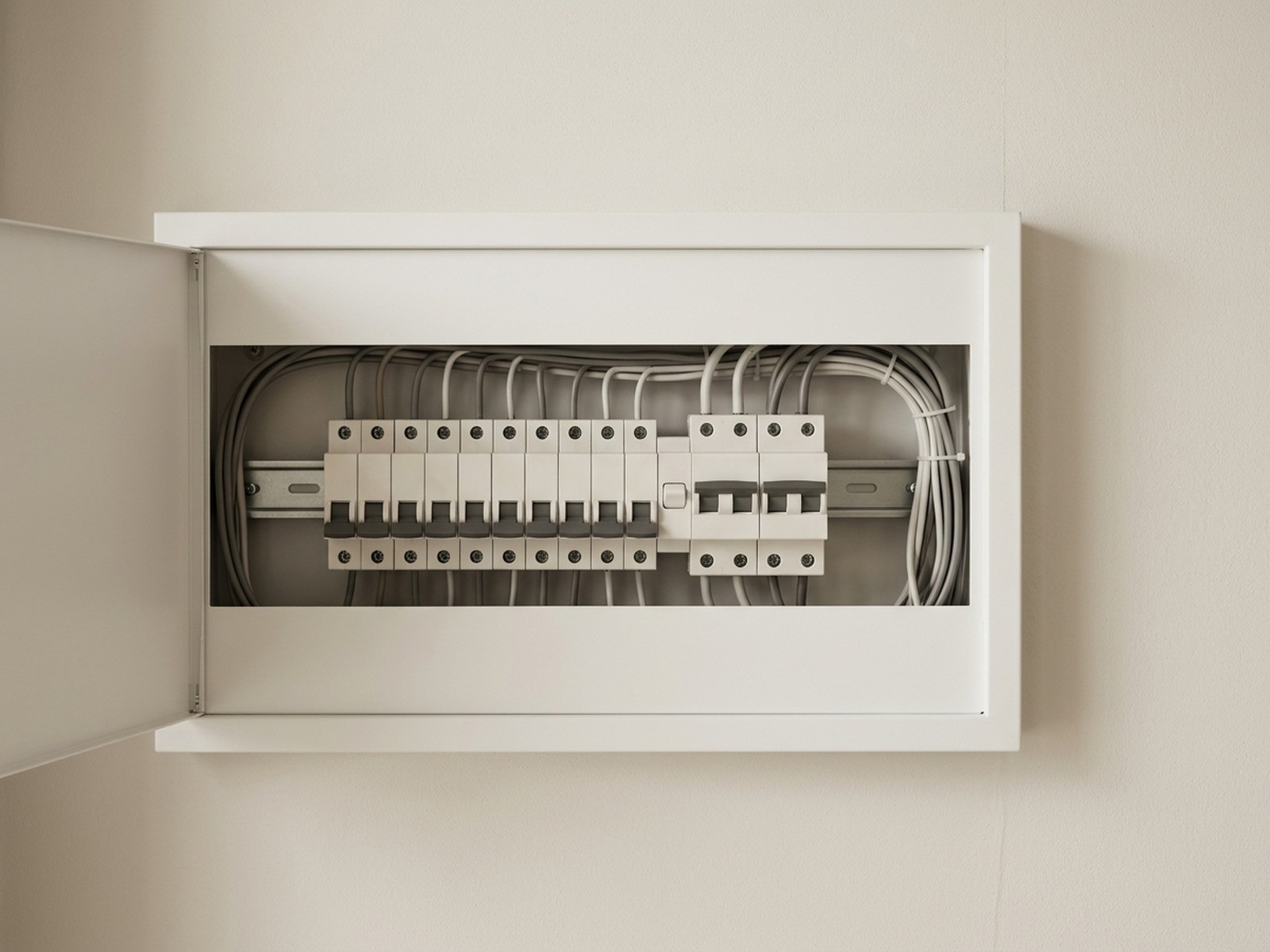
At least two residual current devices must be fitted, protecting all circuits supplying power points and lights, before a home is sold, rented or hired. The State’s guidance on RCD safety switches states plainly that “two is a required minimum, but more than two may be needed”, and the obligation sits under the Electricity Regulations.
RCDs, commonly called safety switches, cut power within milliseconds when they detect current leaking to earth, which is the fault condition that causes electrocution. They are a different device from a circuit breaker and they protect against a different thing.
The timing requirements mirror the smoke alarm rules:
- Selling: RCDs must be installed before the land title is transferred
- Renting: installed in accordance with the Electricity Regulations before the tenancy begins
- Short-stay accommodation: installed at the switchboard before guests stay in the premises
Two further points. Only a licensed electrical contractor may install RCDs or rectify problems identified during testing: this is not homeowner work. And RCDs should be tested using the test button as stated in the manufacturer’s instructions or every three months, whichever is more frequent.
Who is responsible: the seller, the buyer or the landlord?
The owner is responsible, and for a sale that means the seller must have the work done before title transfers, not the buyer afterwards.
| Scenario | Who must ensure compliance | By when |
|---|---|---|
| Selling a home | Seller | Before transfer of ownership |
| Leasing to a new tenant | Lessor / owner | Before the tenancy begins |
| Ongoing tenancy | Lessor / owner | Maintained throughout |
| Short-stay or holiday letting | Owner | Before guests stay |
| Buying a home | Buyer inherits ongoing maintenance | After settlement |
For rental properties the obligation is continuous rather than one-off. Building and Energy states that the lessor or owner of a dwelling that is for rent or hire must maintain the smoke alarms so they remain in working order and compliant. Consumer Protection WA covers the wider set of landlord safety obligations in its rental home safety guidance.
Local governments may take action where compliant smoke alarms are not installed or maintained.
Our Perth landlord’s guide covers the broader management obligations, and our maintenance strategy for investment properties covers how to keep compliance items on a schedule rather than discovering them at lease renewal.
When should you actually do the work?
Book the electrician when you decide to sell, not when settlement is booked. The requirement attaches to transfer of title, which means the last possible moment is settlement day, and the last possible moment is exactly the wrong moment.
A sensible sequence for a seller:
- At the appraisal stage, check the age printed on every smoke alarm and look at the switchboard for RCDs
- Before listing, book a licensed electrical contractor to assess both and quote the work
- During the campaign, have the work completed: a compliant switchboard and current alarms are also a small but real reassurance to buyers at a home open
- Before settlement, keep the electrician’s documentation with your settlement paperwork
- Hand over the documentation to the buyer with the keys
Doing it early costs the same and removes a category of settlement-week risk entirely. Doing it late means competing for a licensed electrician’s time against a fixed date you cannot move.
For landlords the equivalent trigger is lease turnover. Every new tenancy is a compliance checkpoint, and building the check into your turnover routine is far cheaper than discovering a ten-year-old alarm during a dispute.
What does this mean if you are buying?
Compliance is the seller’s obligation, but the consequences of non-compliance land on you once you own the property, so verify rather than assume.
Reasonable steps for a buyer:
- Ask the agent directly whether compliant smoke alarms and RCDs are installed
- Look at the switchboard during a home open. RCDs have a visible test button; an old ceramic fuse board almost certainly has none
- Look at the alarms. A single battery-only unit screwed to a hallway ceiling is a flag
- Ask for the electrician’s documentation to be provided at settlement
- Check both at your pre-settlement inspection, while you still have leverage
A property with an original fuse board and no RCDs is not a reason to walk away. It is a reason to know, before you sign, that switchboard work is coming, and to factor that into what you offer.
Frequently asked questions
Do smoke alarms have to be hard wired in WA?
Yes, in almost all cases. Smoke alarms must be permanently connected to the mains power supply, with a ten-year lithium battery alarm permitted only where there is no hidden space to run wiring and no appropriate alternative location.
How many RCDs do I need in WA?
At least two, protecting all circuits supplying power points and lights. More than two may be required depending on how the property’s circuits are arranged: a licensed electrical contractor will determine what your switchboard needs.
How old can a smoke alarm be in WA?
Not more than ten years old, and not past its expiry date. The date is printed on the unit itself.
Can I install RCDs myself?
No. Installation and any rectification work must be carried out by a licensed electrical contractor.
How often should RCDs be tested?
Press the test button as stated in the manufacturer’s instructions or every three months, whichever is more frequent. This is a simple check any occupant can perform.
What happens if I sell without compliant smoke alarms?
Local governments may take action where compliant smoke alarms are not installed or maintained. Practically, the more immediate risk is to the transaction: the obligation attaches to transfer of ownership, and discovering it in settlement week creates avoidable pressure.
Get it checked before you list
Smoke alarms and RCDs are among the few genuinely binary items in a WA property transaction: either they comply or they do not, and the answer is knowable weeks before anyone needs it to be.
Boutique Realty Perth manages properties and sells homes across the western suburbs, the northern beaches, the Stirling coastal corridor, Perth’s inner city and the Mandurah–Peel region. If you are letting a property, our property management service builds these checks into lease turnover. We are agents rather than electricians: all installation and certification work must be carried out by a licensed electrical contractor.
Call 0414 824 877, email info@boutiquerealtyperth.com.au, or visit Level 3, Suite 17, 23 Railway Road, Subiaco WA 6008.
Keep reading
Related guides.
Maintenance strategy for investment properties: protect the asset, not just the inbox
Routine Rental Inspections WA: Rules and Checklist
Or go to the service this guide supports: property management.
Experience remarkable
Ready to experience remarkable?
Request a free, no-obligation appraisal and we will walk you through what your property could achieve in today’s market.